Business
Starting a Home Tiffin Service: Real Costs, FSSAI Rules, and Pricing That Works
<p>Every office area in every Indian city has the same daily scene: workers and students hunting for affordable, home-style food. Restaurant meals cost ₹150–₹250 a day; a home tiffin service delivers the same comfort for ₹80–₹120 — and the person cooking it can earn ₹30,000–₹60,000 a month from their own kitchen. No shop rent, no staff to start, just cooking skills and a system.</p>
<p>This guide breaks down the real numbers: what it costs to start, which licenses you actually need, how to price so you profit, and how to get your first 20 customers without spending on ads.</p>
<h2>The Real Startup Costs</h2>
<p>Forget the "lakhs of investment" myth. A home tiffin service starts with what a working kitchen already has, plus a few business-specific additions:</p>
<table>
<thead><tr><th>Item</th><th>Estimated cost</th><th>Notes</th></tr></thead>
<tbody>
<tr><td>Extra large vessels & kadhai</td><td>₹3,000–₹5,000</td><td>Bulk cooking needs bigger utensils than family cooking</td></tr>
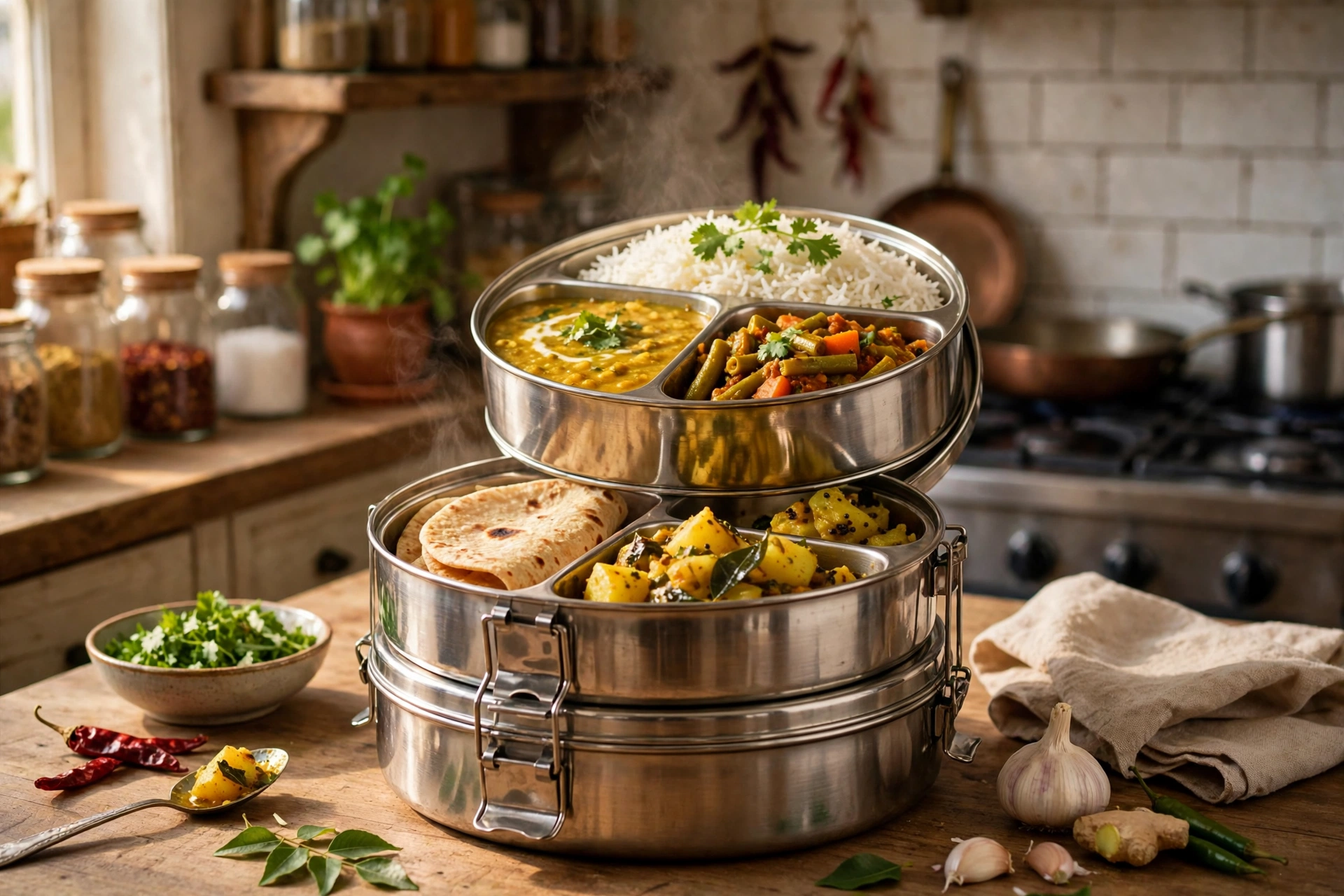
<tr><td>Tiffin carriers (30 sets)</td><td>₹6,000–₹9,000</td><td>Steel, 3–4 containers each; customers return them daily</td></tr>
<tr><td>FSSAI basic registration</td><td>₹100/year</td><td>Mandatory (details below)</td></tr>
<tr><td>Packaging (first month)</td><td>₹2,000–₹3,000</td><td>Extra boxes, foil, bags for non-carrier orders</td></tr>
<tr><td>Second gas cylinder / commercial connection</td><td>₹2,000–₹5,000</td><td>Check local rules for home-business use</td></tr>
<tr><td>Phone + basic marketing</td><td>₹1,000–₹2,000</td><td>WhatsApp Business is free; print 200 pamphlets</td></tr>
<tr><td><strong>Total</strong></td><td><strong>₹14,000–₹24,000</strong></td><td>Recoverable in the first 1–2 months</td></tr>
</tbody>
</table>
<h2>Licenses: What You Actually Need</h2>
<p>The food business has one non-negotiable license and a few good-to-haves:</p>
<ul>
<li><strong>FSSAI Basic Registration — MANDATORY.</strong> Any food business with turnover under ₹12 lakh/year needs this. Apply on the FoSCoS portal (foscos.fssai.gov.in): fill Form A, upload ID and address proof, pay ₹100. The certificate usually arrives in 7–15 days. Display the 14-digit registration number on your packaging and pamphlets — customers trust it.</li>
<li><strong>GST registration</strong> — needed only if turnover crosses ₹20 lakh/year (₹10 lakh in special states). Most home tiffin services stay below this for years.</li>
<li><strong>Shops & Establishment / trade license</strong> — some municipalities require it for home businesses; check your local municipal office. Usually a simple application.</li>
<li><strong>Fire NOC, pollution clearance</strong> — not required at home-kitchen scale.</li>
</ul>
<p>Rule of thumb: start with FSSAI basic registration on day one. Add the rest as you grow.</p>
<h2>Pricing Math That Actually Profits</h2>
<p>This is where most beginners fail — they price by "what feels okay" instead of costing properly. Do the math per tiffin:</p>
<ul>
<li><strong>Food cost:</strong> Add up raw materials per tiffin (dal, sabzi, rice/roti, oil, masala). Typically ₹35–₹50 for a standard veg tiffin.</li>
<li><strong>Packaging + fuel:</strong> ₹8–₹12 per tiffin.</li>
<li><strong>Delivery:</strong> ₹10–₹15 per tiffin (self-delivery nearby) or outsource to a delivery person at a fixed monthly amount.</li>
<li><strong>Total cost:</strong> roughly ₹55–₹75 per tiffin.</li>
<li><strong>Selling price:</strong> ₹90–₹130 for veg, ₹140–₹180 for non-veg/special.</li>
<li><strong>Margin:</strong> ₹30–₹55 per tiffin. At 40 tiffins a day × 26 days, that is ₹31,000–₹57,000 monthly profit.</li>
</ul>
<p>Offer monthly subscriptions (₹2,200–₹2,800/month for veg) — subscribers pay upfront, which funds your raw material purchases and locks in revenue.</p>
<h2>Getting Your First 20 Customers (No Ads Needed)</h2>
<ol>
<li><strong>Start with 5 free trial tiffins</strong> to offices, PGs, and coaching centers within 3 km. One trial tiffin costing you ₹60 can win a ₹2,500/month subscriber.</li>
<li><strong>WhatsApp is your storefront.</strong> Business app, daily menu broadcast to a customer list, and a simple order-by-9pm system. Customers love seeing tomorrow's menu tonight.</li>
<li><strong>Pamphlets in the right 500 meters.</strong> PG accommodations, hostels, small offices, clinics — places where people eat out daily. 200 pamphlets (₹500) in the right buildings beat 2,000 scattered randomly.</li>
<li><strong>Ask for the referral.</strong> After the first week, message every happy customer: "Enjoying the food? One referral from you means a free sweet dish this week." Referrals are 80% of tiffin growth.</li>
<li><strong>List on Swiggy/Zomato only later.</strong> Their 20–25% commission kills home-kitchen margins. Build 30+ direct customers first; platforms are for scale, not survival.</li>
</ol>
<h2>Daily Operations That Do Not Burn You Out</h2>
<ul>
<li><strong>Fixed weekly menu, rotating monthly.</strong> Deciding the menu daily is exhausting; a printed weekly menu lets customers (and you) plan. Repeat popular days.</li>
<li><strong>Order cutoff at 9 PM previous day.</strong> Morning chaos disappears when you know exact counts before you start cooking.</li>
<li><strong>Cook once, pack in sequence.</strong> Batch all rice, then all dal, then all sabzi — assembly-line style. 40 tiffins take 3–4 hours with practice.</li>
<li><strong>Delivery slots, not instant delivery.</strong> Two slots (12–1 PM, 1–2 PM) by area. Customers adapt; you stay sane.</li>
<li><strong>One weekly off.</strong> Sunday closed, announced upfront. Burnout kills more tiffin businesses than competition.</li>
</ul>
<h2>Mistakes That Sink Beginners</h2>
<ul>
<li><strong>Underpricing to "get customers."</strong> ₹70 tiffins get you customers and losses. Price for profit from day one.</li>
<li><strong>Saying yes to every customization.</strong> "No onion-garlic, extra spicy, Jain" for 5 different people turns one kitchen into five. Offer 2 menu variants max.</li>
<li><strong>No advance payment.</strong> Monthly subscribers pay by the 5th; daily customers pay weekly in advance. Chasing payments destroys margins.</li>
<li><strong>Skipping FSSAI.</strong> One complaint without registration, and the business stops. ₹100 and 15 days — no excuse.</li>
</ul>
<h2>FAQ</h2>
<h3>Do I need a separate kitchen?</h3>
<p>No — most successful tiffin services start in the family kitchen. As volume crosses 50+ tiffins, consider a partitioned cooking schedule (family food first, business batch after) or a second setup.</p>
<h3>How do I handle food safety?</h3>
<p>Fresh cooking daily (no overnight curries for customers), clean water, covered packing, and delivery within 2 hours of cooking. These four habits prevent 99% of problems.</p>
<h3>What if a customer does not pay?</h3>
<p>Advance-payment policy prevents this. For the rare default, one polite reminder, then stop service — never cook on credit beyond a week.</p>
<h3>Can I do this part-time alongside a job?</h3>
<p>Dinner-only tiffins (evening delivery) work part-time — many do 20–25 dinner tiffins after office hours. Lunch service needs full mornings free.</p>
<h2>Conclusion</h2>
<p>A home tiffin service is one of the most honest businesses in India: real food, real customers, real money from your own kitchen, starting under ₹25,000. Get the FSSAI registration, price with real math, win your first 20 customers within 3 km, and protect your Sundays. The demand for ghar-ka-khana is not going anywhere — the only question is who in your neighborhood serves it first.</p>
Share this article
About the Author
Related Articles
Business
Starting a Small Cloud Kitchen in India: Costs, Licences, and Delivery-App Realities
Creator

Business
Starting a Home Bakery Business in India: FSSAI, Pricing, and Finding Your First Regular Customers
Creator
Business
Starting a Small Poultry Farm in India: Costs, Licenses, and First-Year Realities
Creator
Business
गांव में CSC सेंटर कैसे खोलें: लागत, कमाई और आवेदन की पूरी प्रक्रिया
Creator